
How I Accidentally Built the Academic Version of a Vegas Buffet
Originally posted September 24, 2025
HOMESCHOOLLIFECHARLOTTE MASON
Jessi
7/25/20263 min read
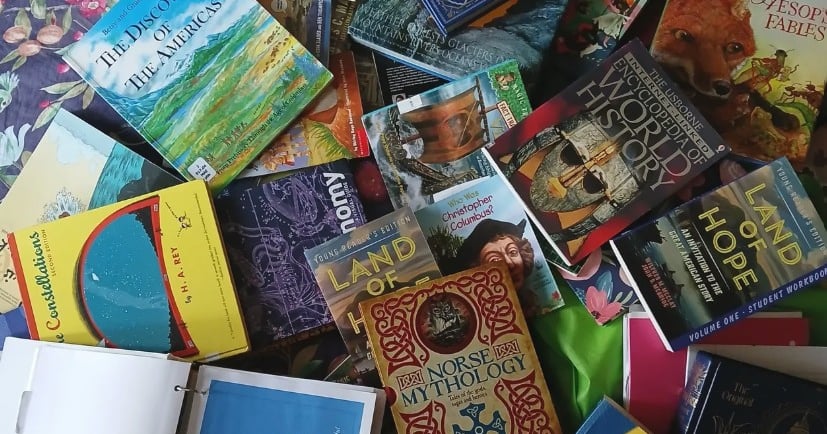
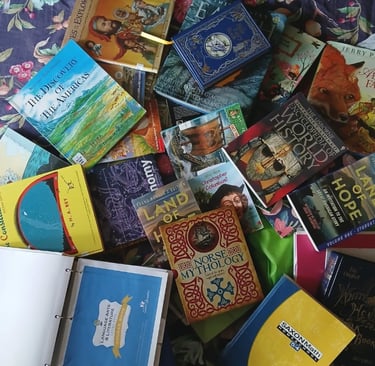
There’s something intoxicating about the beginning of a new school year. The smell of sharpened pencils, the unbroken spines of books, the crisp promise of “this time, I’ll be organized.” Unfortunately, if you’re like me, intoxicating quickly turns into intoxicated, and suddenly you’ve got not one, but two math curriculums, two grammar programs, and a nervous system that looks like it was wired by an overcaffeinated squirrel.
Yes, that was our first month of homeschooling. We launched officially on September 1, and by September 27 I had already staged what can only be called a curriculum coup d’état. My dear husband, with the patience of a monk and the bluntness of someone who doesn’t want to trip over one more library stack in the living room, kindly pointed out that perhaps—just perhaps—I was overcomplicating things. He sat, listened to my manic TED Talk about why we needed both Saxon and The Good and the Beautiful math, and then dropped the kind of wisdom only spouses can deliver: “Why don’t you just… do less?”
This, of course, was offensive. Me? Overcomplicate things? That would be like accusing Dorothy Zbornak of being sarcastic. And yet, after sulking, pacing, and finishing an online course in children’s literature (because naturally I need extracurriculars in my extracurriculars), I realized he was right. Cue Elsa belting “Let It Go” in the background.
Here’s the irony: my original plan was streamlined, noble, downright Charlotte Mason-esque. Saxon math, Hillsdale history and civics, Harbor and Sprout for science, mountains of quality literature, and a co-op that was covering Shakespeare, music, art appreciation, and nature. Simple. Beautiful. Doable. And then along came The Good and the Beautiful—free, glossy, and whispering “Don’t you want me?” like a toxic ex. Of course, I said yes. Then I doubled down, refusing to drop Saxon.
To make matters more absurd, I signed us up for a second co-op because it offered paleontology. Dinosaurs are persuasive. If you tell me “art and paleontology,” I’ll apparently hand you my calendar and say, “Please, fill this with more obligations.”
Did I cut anything when I kept adding? No. Because I’m an optimist who believes everything is possible—until reality taps me on the shoulder and whispers, “You’re not running NASA, you’re homeschooling two kids.”
So after much reflection (and a few passive-aggressive sighs at my husband for being right), here’s where we’ve landed:
Math: Saxon. The Good and the Beautiful is still in a binder, sitting there like a sad prom date, but we’ve got LEGO math goals to conquer and that’s enough.
Language Arts: The Good and the Beautiful stays. It’s “open and go,” which means I don’t have to stay up until 1 a.m. reinventing grammar lessons like I’m gunning for a Nobel Prize.
Literature: Still the backbone. Family read-aloud is The Green Ember, book club is Alice in Wonderland. Shakespeare with our co-op. And if my kids can discuss Macbeth before bedtime, I consider that a parenting win.
History: Hillsdale, reinforced with our book choices. Because nothing says “family bonding” like debating the Federalist Papers over tacos.
Science: Harbor and Sprout, plus the paleontology from co-op. Dinosaurs have tenure here.
Co-ops: One stays fully intact. The other is Elsa-ed—frozen out for grammar and writing, but still alive for art and science.
Of course, this is only the skeleton of our learning. Layered on top are ballet, music lessons, and—next semester—foreign languages, because why not ensure our overcomplication is multilingual?
What I’ve learned in this first month is simple, but not easy: homeschooling isn’t about proving you can do everything. It’s about choosing the right things and actually doing them well. Two math programs don’t make your kids twice as smart. They just make you twice as tired.
So here we are: still ambitious, still learning, but with enough clarity to let some things fall away. Because at the end of the day, the goal isn’t to raise over-scheduled prodigies. It’s to raise kids who love to learn, can quote Shakespeare at dinner, and—if we’re lucky—still talk to us when they’re 30.
And if that isn’t beautiful, I don’t know what is.
Jessica Westerman
Barefoot realist with a side of sarcasm. Homeschool fails & wins, strict budget, celiac grudges, grief, faith, and figuring out who I am now.
Reach out
catchamoon1977@gmail.com
Instant PDF delivery on all digital orders
Weekly reflections sent every Sunday morning (If life cooperates)
© 2026 Jessica Westerman-Written and designed at a kitchen table in rural Illinois.